How to Build Pure Swing Connection Without Muscling the Dance
Why Your Swing Dance Feels Heavy and How Physics Changes Everything
Arm fatigue, aching shoulders and a partner connection that feels more like a tug-of-war than a conversation are common frustrations in Lindy hop, East Coast, West Coast and modern swing. The problem is rarely a lack of enthusiasm. More often, the body is trying to create movement in the wrong place. When the arms carry the job of initiating, stopping and redirecting the dance, even a simple pass-by can feel laborious. A swingout becomes a sequence of catches, clamps and hurried corrections instead of a buoyant exchange of rhythm.
Muscling a cue creates delay because force travels through soft tissue before the rest of the body responds. A bent wrist may move first, followed by the elbow, shoulder and torso, producing a lagging signal rather than a clear invitation. The other dancer may then brace, pull back or guess, creating false leads and defensive tension. A better approach treats connection as a living structure, similar to the elastic embrace in partner dance, where bones provide support and the surrounding tissues adapt. With core counterbalance, neutral posture and elastic tone, movement can travel through the whole body and feel remarkably light.
The Two Fundamental Forces of Elastic Connection
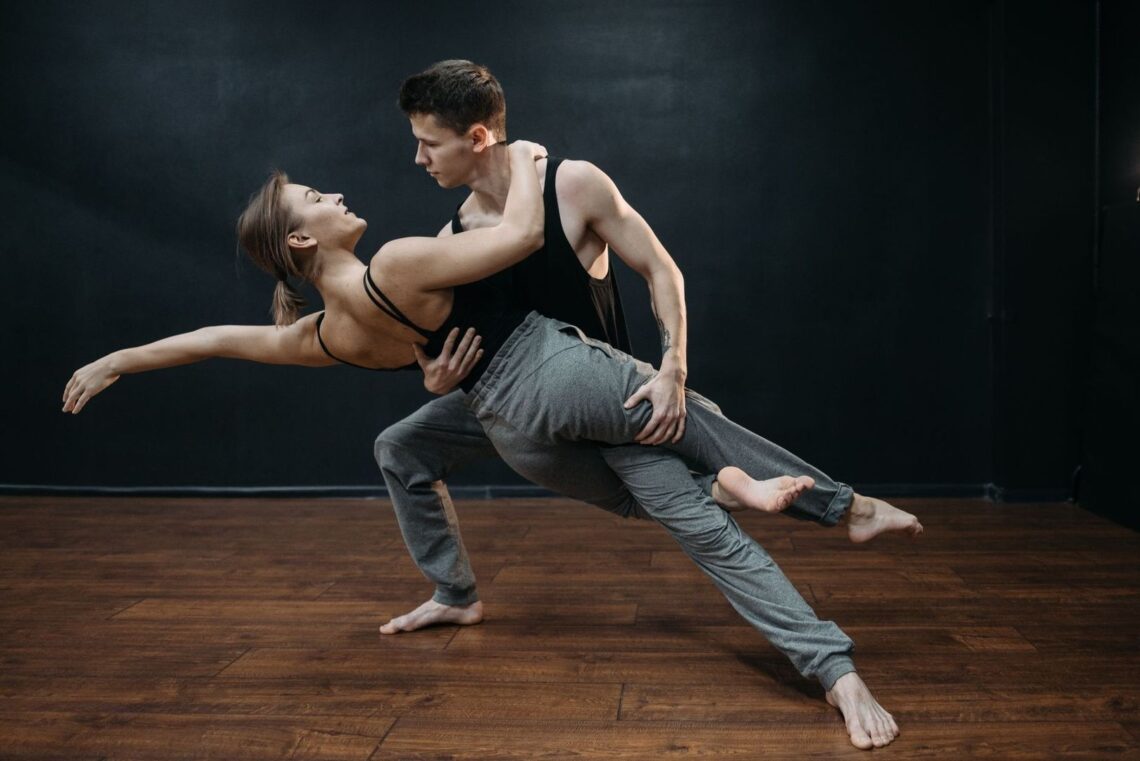
Most swing connection can be understood through two complementary actions: compression and leverage, often experienced as stretch. Compression is not a push from the hands. It is an elastic absorption towards the centre, created when both dancers remain organised through the torso and allow their shared momentum to meet. The elbows stay available, the wrists remain quiet and the body receives information without collapsing. Leverage or stretch works in the opposite direction. Rather than pulling with the biceps, each dancer redirects shared body weight through the floor, allowing the arms to transmit a change in distance while the centre remains active.
This distinction matters because the arms are excellent communicators but poor engines. A strong arm can produce an immediate shape, yet it cannot reliably coordinate timing, balance and direction across the whole body. A connected dancer sends information from the ground, through the legs and centre, into a softly toned arm. The result is not limpness. It is responsive firmness, the same quality that makes a spring useful: stable enough to transmit energy, flexible enough to adapt.

| Arm pulling mechanics | Physics-based partner connection |
|---|---|
| Biceps initiate movement | Legs and centre redirect movement |
| Wrists bend or grip | Hands remain relaxed and supportive |
| Shoulders rise and clamp | Shoulders stay mobile over the ribs |
| One dancer creates the force | Both dancers share weight and timing |
| Signals arrive late and feel abrupt | Elastic tension communicates smoothly |
| Connection becomes tiring | Connection becomes sustainable and rhythmic |
There is no single ideal amount of stretch for every partnership. Height, body shape, tempo, floor surface and personal movement history all affect the appropriate tone. A dancer who is labelled “heavy” may be overextending, bracing through the arms or offering more counterweight than requested, but the other partner may also be contributing by pulling, rushing or failing to make a clear invitation. The useful question is not who is at fault. It is whether the connection is shared, proportionate and comfortable.
Anchoring from the Center Instead of the Shoulders
A stable centre gives the arms something intelligent to communicate. The abdominal wall, pelvis, back and breath work together to keep the torso organised while the legs travel. The latissimus dorsi, the broad muscles running through the back, can help connect the arms to the torso and transfer movement towards the floor. This does not mean squeezing the shoulder blades or stiffening the back. It means allowing the arm to feel attached to the body”s centre rather than hanging from an isolated shoulder joint.
Core control is important across dance styles because it supports alignment, balance and coordinated weight transfer. Guidance on the role of the core in dance technique likewise links trunk stability with control and injury prevention. Neutral posture is the practical starting point: the head balances over the spine, the ribs remain comfortably over the pelvis, the knees are available and the shoulders can breathe. This is not a rigid military stance. It is a poised arrangement in which no body part has to compensate for another.
- Check that the elbows rest slightly in front of the rib cage rather than drifting behind the torso.
- Notice whether the shoulders rise when a turn or swingout begins. If they do, soften the neck and exhale.
- Test the wrists. A neutral wrist usually indicates that the hand is transmitting information rather than gripping.
- Feel the feet before initiating movement. Pressure through the floor should change before the arm reaches.
- After a rotation, return attention to the pelvis and ribs. If the torso has twisted away from the feet, reset before adding speed.
Short posture practices can be useful outside the studio as well. Mountain Pose, Staff Pose and balancing exercises are often used to develop vertical alignment, proprioception and awareness of the centre. Even a few minutes of controlled breathing and quiet standing can reveal habitual shoulder tension. The aim is not to imitate a yoga shape on the dance floor, but to build the body awareness that lets a dancer notice tension before it becomes a clamp.
Four Real-Time Calibration Drills for Instant Weightlessness
These drills are designed to make connection easier to feel before speed and styling enter the picture. They can be practised alone, with a trusted partner or during a lesson. The quality of the sensation matters more than the size of the movement. If pain appears, stop and adjust. A partner should never have to tolerate discomfort in order to provide a useful learning experience.
- The Wall Press test. Stand facing a wall with one palm resting against it, elbow soft and shoulder relaxed. Without leaning from the shoulder, press gently through the hand until the ribs and abdominal wall respond. Notice the difference between a whole-body connection and a localised arm push. Now step backwards while maintaining a light, steady relationship with the wall. The body should move as one unit, with the feet and centre organising the action. This is the sensation to seek when offering compression to a partner.
- The Two-Finger Hook drill. With a partner, connect using only two fingers from each hand, choosing a secure but non-gripping contact. Walk a few steps, change direction and try a basic rotation. If the fingers slip, the issue is usually not that more force is needed. Check whether the movement is clear through the centre and whether both dancers are arriving on time. The drill exposes excess tension immediately: a clenched forearm, rigid wrist or lifted shoulder becomes impossible to hide behind a full-hand grip.
- The Slow-Motion Walk Back. Begin facing a partner with a comfortable open connection. One dancer gradually walks backwards while the other follows the changing distance, moving at half speed. Keep the spine long, the knees responsive and the elbows softly in front of the ribs. Pause at several points and ask whether the stretch is shared or whether one person is hanging from the other. This slow calibration is especially helpful for dancers who have been told they are heavy, since it separates useful counterbalance from unnecessary momentum, overextension or defensive bracing.
- The Springboard Release. Create a gentle stretch away from a partner, then release the excess resistance without collapsing. Allow the elastic rebound to return into a small triple step or rock step. The release should feel like energy becoming rhythm, not a sudden launch. Start with tiny movements and gradually add tempo. In a swingout, this quality helps the follower return towards the centre and helps the leader receive that return without catching or hauling. The springboard is shared: both dancers regulate the amount of energy rather than one person supplying all of it.
These exercises also provide valuable feedback about mismatched expectations. One partner may prefer a compact, contained connection while another enjoys a larger counterbalance. Neither preference is automatically wrong, but the partnership needs negotiation. Reduce the range, lower the speed and make the next intention more obvious. If a movement repeatedly causes pain, visibly signal the problem and stop the action. Specific communication is kinder and more effective than silently avoiding a partner while the same mechanics continue with someone else.
Building Floor Chemistry Through Subtle Communication
Great social dancing feels musical because the physical conversation leaves room for interpretation. A lead does not need to dictate every inch of a pathway, and a follow does not need to become passive or weightless. Both dancers listen through the connection, respond to timing and adjust to the song. A soft tone can remain present through a turn, break or high-energy swingout without becoming rigid. Think of the arms as a volume control: clear enough to be heard, never so loud that they drown out the rhythm.
- Match the partner”s range before adding larger shapes or faster rotations.
- Use smaller steps when the floor is crowded, keeping momentum organised and predictable.
- Maintain supportive contact over stable areas of the body rather than squeezing soft tissue or joints.
- Ask for consent before dips, lifts, sudden drops or unfamiliar tricks.
- Respond to discomfort immediately, without treating a safety adjustment as a criticism.
Respecting boundaries is not separate from technique. It creates the trust that allows technique to function. A partner who knows that a movement will be reduced when needed can stay relaxed, and a relaxed dancer can offer clearer timing and more nuanced musical choices. Safer swing instruction also places connection, leverage and clean lead-and-follow mechanics alongside energetic movement, including in modern country swing settings. The strongest chemistry on a social floor is therefore not built from impressive force. It comes from attention, consent, adaptability and the shared pleasure of finding the beat together.
Step Onto the Floor with Effortless Swing Rhythm
Effortless connection is not the absence of strength. It is strength used economically. Replace shoulder-driven effort with a stable centre, neutral posture and elastic arms. Let the feet and torso redirect weight before the hands communicate the change. Compression should absorb into the body, while stretch should emerge from shared counterbalance rather than a biceps-powered pull. When those principles are working, the connection remains alive without becoming heavy.
Use the Wall Press, Two-Finger Hook, Slow-Motion Walk Back and Springboard Release during the next practice session, then carry one small check onto the social floor. Notice the shoulders, feel the feet and ask whether the connection is shared. With steady calibration, swingouts become more buoyant, turns become kinder on the joints and triple steps can rebound naturally from the music. The reward is a dance that lasts longer, feels safer and leaves more room for the real magic of swing: rhythm, playfulness and two people moving with ease.